

Budgeting 101 does not mean mastering every finance term on day one. It means knowing where your money goes, choosing a few priorities, and checking in often enough that surprises stay small.
The habit matters even when life is busy. A NerdWallet survey found about three in four U.S. adults keep a monthly budget, yet 84% of those budgeters said they still exceed it. And the FINRA Foundation found that only four in ten adults use websites or apps for budgeting or broader money management, which leaves a lot of room for a simple spreadsheet or app you will actually open.
Why bother with a budget?
A budget is a plan for your cash flow: what comes in, what must go out, and what you want left for savings or goals. Without that map, it is easy to overspend in quiet ways (delivery, subscriptions, small shopping trips) and wonder why saving feels impossible.
Expense tracking is the habit that feeds the plan. When you know your real numbers, you can:
- Pay bills on time with less stress
- Build an emergency cushion over time
- Make intentional tradeoffs (dining out vs. a vacation fund)
- Talk about money more clearly with a partner
You do not need to be “good at math.” You need a repeatable process.
A simple way to start this week
If you've been avoiding getting started or feeling overwhelmed at how much work it will take, start simple and try this 4-step loop:
- List income: Use take-home pay if that is what hits your bank.
- List fixed bills: Rent, utilities, insurance, minimum debt payments, childcare.
- Estimate flexible spending: Groceries, gas, dining, personal care. Use last month as a guess if needed.
- Name a savings target: Tweak your spending levels to arrive at a monthly savings target you aspire to hit.
Review once a week for 15 minutes. Adjust categories when reality disagrees with the plan. That is budget management in practice.
How to budget step by step
The four-step loop above is the outline. Expand it like this for your first month:
- Choose a month that is a standard and repeatable for the plan: Every month is different and one-off expenses pop up all the time, so make sure you pick a good starting point historical month that represents your usual expenses.
- Total take-home income: Add paychecks and any regular side income that hits checking. If pay varies, use a conservative average from the last three months or your lowest recent month until you build a buffer.
- Subtract fixed bills first: List rent, utilities, insurance, loan minimums, childcare, and subscriptions you plan to keep. What is left is the pool for flexible spending and savings.
- Estimate flexible categories: Groceries, gas, dining, personal care, and household supplies. Pull one bank statement if you are guessing; round up slightly on categories where you usually overspend.
- Pay yourself (savings) on purpose: Schedule emergency savings, retirement, or extra debt payment like a bill. If you only “save what is left,” there is often nothing left—aim for income minus fixed, flexible, and savings to land near zero.
- Track weekly, adjust monthly: Log or sync transactions, assign categories, and note pacing (for example, how much of your grocery target is used mid-month). At month end, change one or two targets that were consistently off—not the whole plan at once.
Keep category names stable for two or three months so trends are easy to read before you rename anything.
Free template: expense tracker and monthly P&L
If you like spreadsheets, start with a structured workbook before you commit to an app.
Related free template: Budget, Expense & Savings Template — download free Excel or Google Sheets copies to track income, expenses by category, savings, and month-over-month trends.
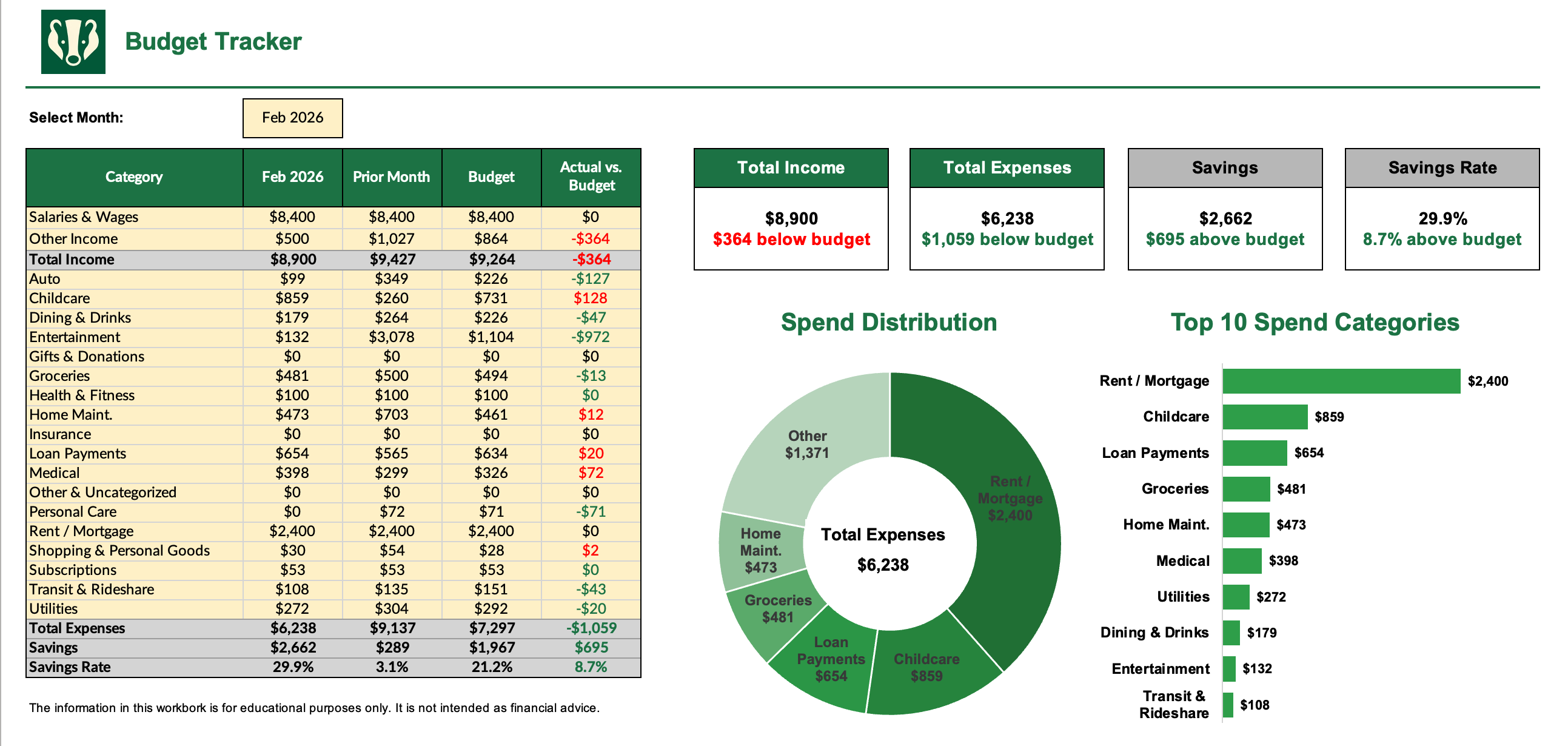
A simple template gives you category totals and a savings snapshot without custom formulas on day one.
Free plan on BudgetBadger
Spreadsheets work well for learning. An app helps when you want accounts connected, categories updated, and insights without rebuilding rows each month.
BudgetBadger offers a permanent Free plan (no credit card required to start) so you can explore expense tracking and budgeting at your own pace.
Okay, now I have a budget. What's next?
Building the plan is the first win; maintaining it is what turns numbers into progress.
- Rhythm: A 10–15 minute weekly check for pacing and upcoming bills, plus a 30–45 minute monthly close to set next month’s targets. Revisit the full plan when income, housing, debt, or family size changes.
- Fine-tuning: Raise categories that are always too tight; lower only where you will actually change behavior. Split vague buckets (like “shopping”) if you cannot see where money went.
- When to rewrite: Job or pay changes, new bills, new goals—or the same category missing three months in a row for everyday spending. One-time spikes are a note, not always a full rebuild.
- Accountability: Pick one goal the budget serves, automate savings and bill pay where you can, and share one view with a partner if you manage money together. Going over a category is a signal to adjust, not a failure.
- Goals on the page: Emergency fund and debt payoff as fixed lines; bigger purchases as small monthly sinking-fund transfers.
Related reading: How Budgeting Can Save You Money · Subscriptions and Recurring Bill Tracking All in One Place · Category Rules That Actually Stick