

Every budget lives or dies on categorization. If transactions land where they belong, your budget targets mean something, your trends tell the truth, and expense management feels like steering rather than repairing. If they drift, over time you stop trusting the dashboard. The best budget app is not the one with the most charts; it is the one that helps you keep the underlying data honest without turning you into a full-time accountant.
Category rules exist for exactly that job: explicit “when this happens, categorize like this” logic that brings consistency to automatic categorization. While AI and machine learning can categorize reasonably accurately, they often don't know your preferences yet, especially in the early stages of budgeting. Instead, you can teach the system to categorize based on the patterns you already know - merchant fragments, memo keywords, recurring amounts, etc. This puts you in control, setting up future automated accuracy with just a few simple clicks.
Ad‑hoc fixes don't scale
Humans are good at intent; software is good at repetition. When you manually recategorize the same coffee shop twelve times, you are spending attention on a solvable problem. The friction is small per incident, but large cumulatively. Financial consolidation of a household with many accounts becomes a huge manual burden.
Ad-hoc fixes also encode memory in fragile places. You remember “that charge is usually groceries,” but your partner does not. Three months later, the habit resets and your category story wobbles again.
The goal is not to remove judgment. The goal is to remove predictable judgment—the kind you have already made a hundred times.
Category rules in practice
A useful rule reads like a sentence you would say out loud: if a transaction matches a pattern you care about, assign it to the category that matches your budget management philosophy.
Common patterns include:
- Merchant text — The most common pattern, a store name you recognize is a quick and easy way to auto-categorize your data and teach the system your preferences.
- Memo text — Memos often include helpful identifying keywords often not in the merchant field that you may want to categorize differently for the same merchant, e.g. "Costco Gas" instead of just "Costco".
- Amount — When combined with merchant or memo text, a fixed fee for a high frequency merchant can be a strong signal when text strings are messy, e.g. Amazon subscriptions you want to keep separate from all your impulse purchases.
- Account — When you use specific linked accounts for specific transaction types, this can be a helpful category setting criteria.
The best rules are narrow enough to be safe and broad enough to save time. You are aiming for “almost always right,” then refining when reality doesn't match your intent.
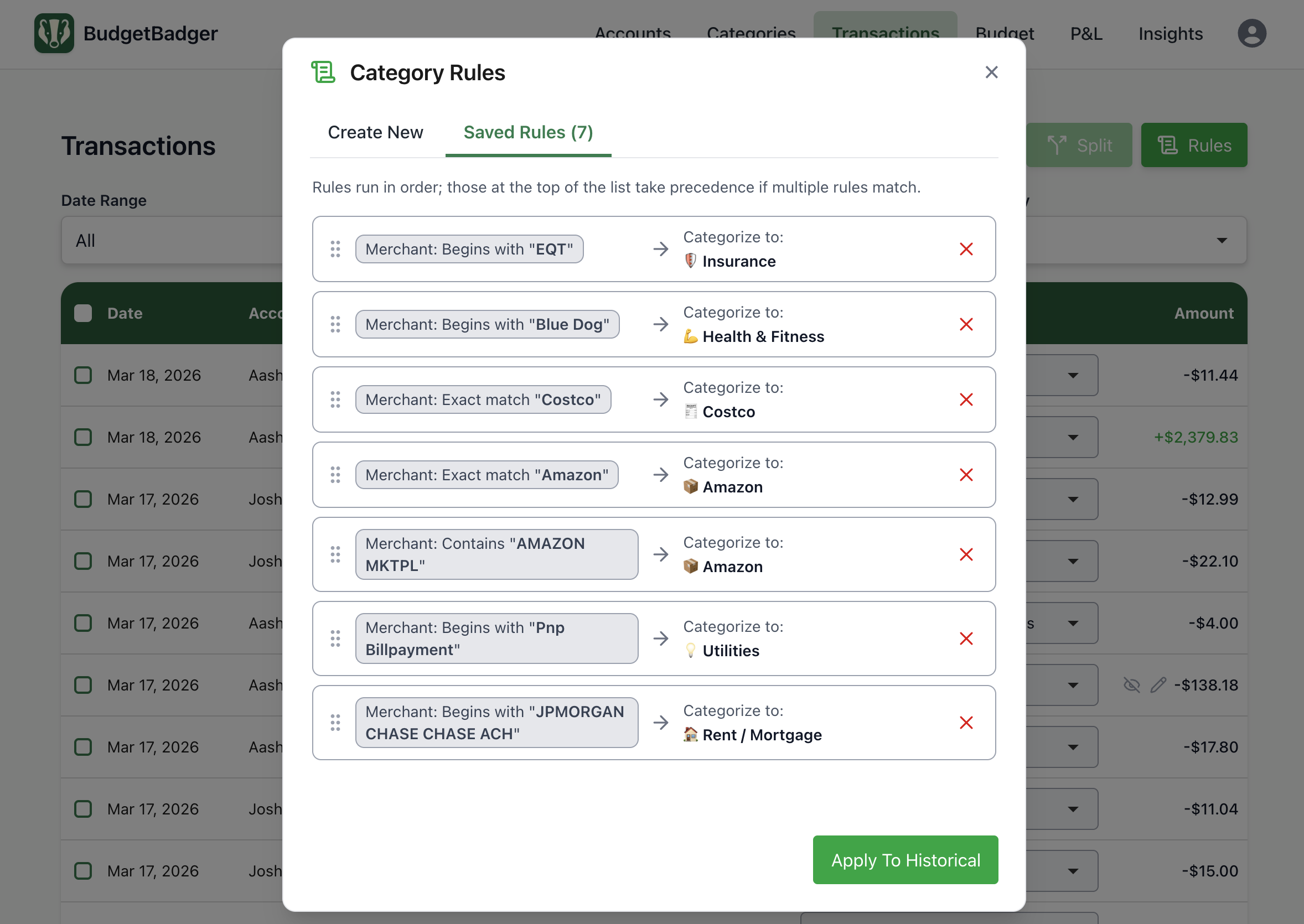
Category rules turn the decisions you have already made into automation - fewer errors and more accurate budgets.
Keep rules accurate over time
Automation only stays helpful if it still matches how you live. A five-minute tune-up now and then beats a surprise month where every table and chart is wrong.
Treat it as a lightweight routine: new transaction review → reassign categorize (if needed) → add rules for repeated mistakes → split the one-off blended transactions. When rules drift, that whole flow starts to feel heavier than it should. Simple, quick maintenance habits are what keep expense tracking useful without turning you into a nightly bookkeeper.
Related reading: Split Transactions for Cleaner Categories · Budgeting 101: Get Started · Subscriptions and Recurring Bill Tracking