
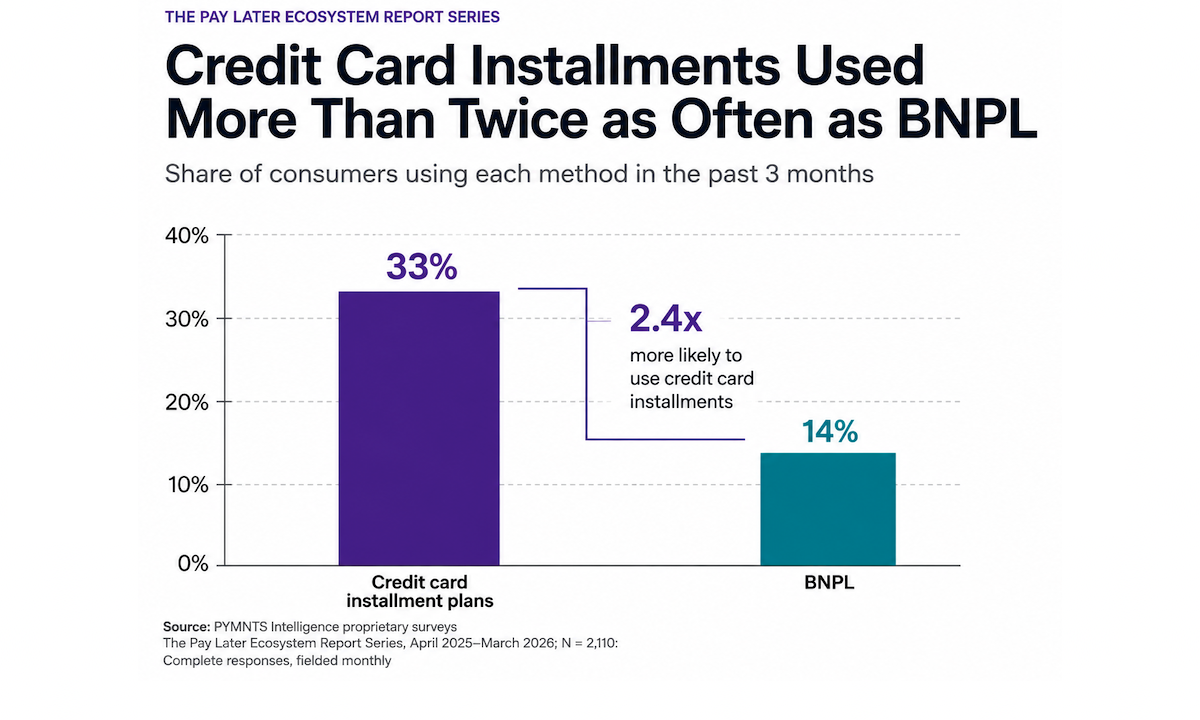
One in three US consumers now uses a credit card installment plan, according to PYMNTS Intelligence research drawn from eight surveys of approximately 2,500 US adults each. That single figure reframes the buy-now-pay-later story: BNPL was supposed to pull customers away from credit cards, but card issuers have embedded the same split-payment feature directly into existing accounts, and consumers are choosing it at more than twice the rate of standalone BNPL services.
Card Installments Now Dominate the Pay-Later Market
The PYMNTS "Pay Later Ecosystem Report" finds that across all eight survey waves, credit card installment adoption ran at more than double the rate of dedicated BNPL apps and services. The mechanics explain the gap. Card issuers place installment options inside the accounts and payment relationships consumers already use daily, removing the friction of signing up with a separate provider. For households already carrying a credit card, opting into a payment plan can be as simple as selecting a checkbox at checkout or inside a banking app, which is the kind of low-effort flexibility that budget-conscious shoppers tend to prefer.
The Consumer Financial Protection Bureau has documented the broader expansion of pay-later options at retail, showing that more merchants are offering BNPL loans. Yet the PYMNTS data suggests that even as retail access to standalone BNPL grows, consumers are gravitating toward the installment version baked into their existing card relationships rather than opening new BNPL accounts.
Source: PYMNTS.com
Gen Z Is Driving the Shift Faster Than Expected
The generational numbers are particularly striking. BNPL built its early brand among younger shoppers, yet Gen Z is now choosing card-based installments at a rapidly growing rate. Gen Z credit card installment use climbed from 31% in April 2025 to 47% by March 2026, a 16-point jump in less than a year. Over that same period, Gen Z BNPL use moved only from 21% to 23%, a gain of just 2 points. Millennials and bridge millennials followed a broadly similar pattern, suggesting the trend is not limited to the youngest cohort.
This matters for household budgeting because younger consumers who might have relied on a patchwork of standalone BNPL apps are consolidating their payment flexibility inside a single card account. That can simplify tracking monthly obligations, though it also means installment balances now sit alongside revolving credit card debt in the same account, something households need to monitor carefully. The Federal Reserve Bank of New York's household debt data provides context on how installment and revolving debt interact at the consumer level across different income groups.
Higher Earners Use BNPL More Than Lower Earners
Income patterns in the data add another layer of nuance. Standalone BNPL use consistently ran higher among consumers earning at least $150,000 than among those earning under $50,000. In November, the respective BNPL usage rates were 22% for higher earners versus only 7% for lower earners. By March, that gap narrowed somewhat, with rates of 20% and 10%, but higher-income consumers still used BNPL more frequently.
That finding pushes back on the narrative that BNPL primarily serves consumers who cannot access credit. Across the income spectrum, pay-later tools appear to function as cash-flow management instruments rather than emergency financing, a shift in how households think about breaking up large purchases into predictable payments.
What This Means for Household Payment Decisions
For consumers, the picture that emerges from the PYMNTS research is one of consolidation. Pay-later demand, which BNPL providers spent years cultivating, is increasingly being met inside the credit card products tens of millions of households already carry. Card issuers can offer installment flexibility without asking customers to adopt a new app, create a new account, or share financial data with an additional provider. As of March 2026, 47% of Gen Z cardholders were already taking advantage of that embedded flexibility, a share that would have been difficult to predict even one year earlier.
The broader shift points toward pay-later becoming a standard feature of card and banking products rather than a separate category, reshaping how households structure their monthly spending and debt obligations.
Final Thought: With credit card installment use more than doubling BNPL adoption and Gen Z uptake jumping 16 points in less than a year, consumers managing monthly budgets should account for installment plan balances alongside regular card charges when tracking what they owe each billing cycle.