

Running a small Etsy shop or Shopify store means wearing many hats, and bookkeeping often ends up at the bottom of the priority list. But the accounting method you choose shapes how much time you spend on your books, how your tax bill looks at year end, and how clearly you can see whether your business is actually profitable. Most small ecommerce sellers never consciously pick a method. They either default to whatever their software suggests or copy what a larger business does. That usually means landing on accrual accounting when cash accounting would serve them far better.
This post breaks down exactly what each method means, where each one makes sense, and why the U.S. Small Business Administration and tax authorities treat the two approaches very differently depending on business size and structure.
Source: Basis 365 Accounting
How the Two Methods Actually Work
Both cash and accrual accounting rely on the same underlying double-entry bookkeeping framework, a system that has been the backbone of business finance since 16th century Europe. As Investopedia explains, double-entry bookkeeping requires that every debit entry have a matching credit entry, keeping the books in balance and surfacing errors quickly. The difference between cash and accrual is not about that underlying structure. It is about timing: when exactly you record income and expenses.
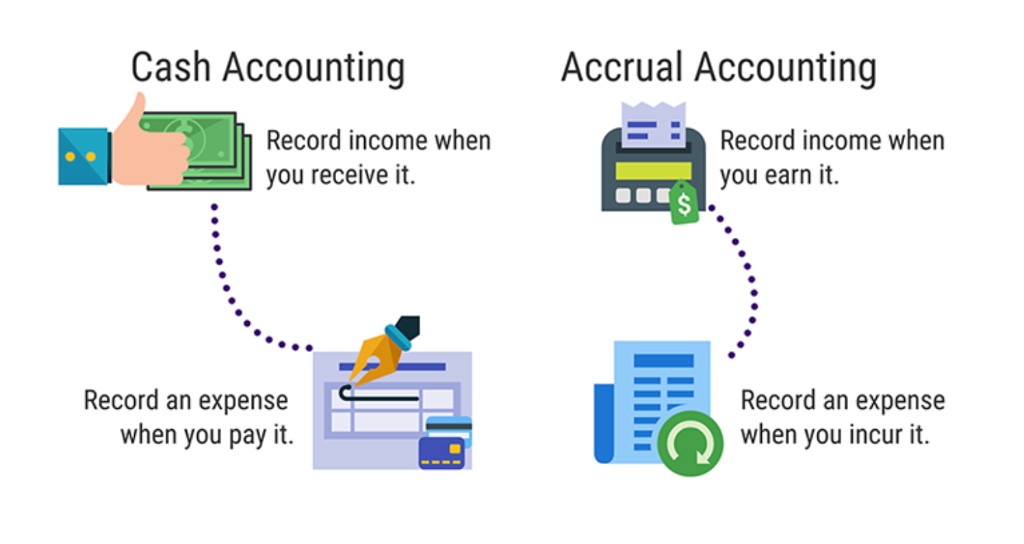
Cash accounting records revenue when money actually lands in your bank account and records expenses when you actually pay them. If a customer buys a handmade necklace on December 28 but Etsy's payout does not hit your account until January 3, that income appears in January under cash accounting. Similarly, if you order $400 in craft supplies in late November and pay the invoice in December, the expense shows up in December.
Accrual accounting records revenue when it is earned, not when cash arrives, and records expenses when they are incurred, not when they are paid. That December 28 sale would appear as December income even though the cash has not moved yet. The November supply order would show up as a November expense even if the invoice is not paid until December.
The accounting equation (assets = liabilities + equity) underpins both methods, but accrual accounting introduces accounts receivable and accounts payable line items that cash accounting simply does not need. For a solo seller managing 50 to 200 orders a month, those additional line items add complexity without delivering proportional insight.
Why Cash Accounting Wins for Most Small Sellers
The case for cash accounting in small ecommerce businesses comes down to three practical advantages: simplicity, tax timing, and alignment with how small shops actually operate.
Simplicity. Under cash accounting, your books reflect your bank account. When you receive an Etsy payout, you record income. When you pay for packaging, postage, or advertising, you record an expense. There is no need to track open invoices or accrued liabilities. The IRS Publication 334 Tax Guide for Small Business explicitly allows most small businesses and sole proprietors to use the cash method, and many self-employed sellers are eligible by default. For a seller filing Schedule C, cash-basis records translate directly and cleanly into the form.
Tax timing. Cash accounting lets you control when income and expenses hit your books within legal limits. If you prepay a significant supply order in December, that deduction lands in the current tax year, potentially reducing your taxable income before year end. Under accrual, that expense may not be deductible until the goods are received or used. For small sellers operating on thin margins, front-loading legitimate deductions can meaningfully reduce a near-term tax bill. The IRS guidance on managing your business confirms that the timing of income and expense recognition is one of the most consequential decisions a small business owner makes.
Alignment with ecommerce reality. Most Etsy and Shopify sellers do not extend credit to customers. Sales are paid at the moment of purchase. There are no open invoices aging in a receivables ledger. Because revenue arrives almost simultaneously with the sale, the gap that accrual accounting is designed to bridge simply does not exist for the majority of small ecommerce shops. Etsy, for instance, collects payment from buyers directly and disburses funds to sellers on a regular schedule, as outlined in Etsy's seller fee and payment policies. That payout structure maps naturally onto cash-basis recording.
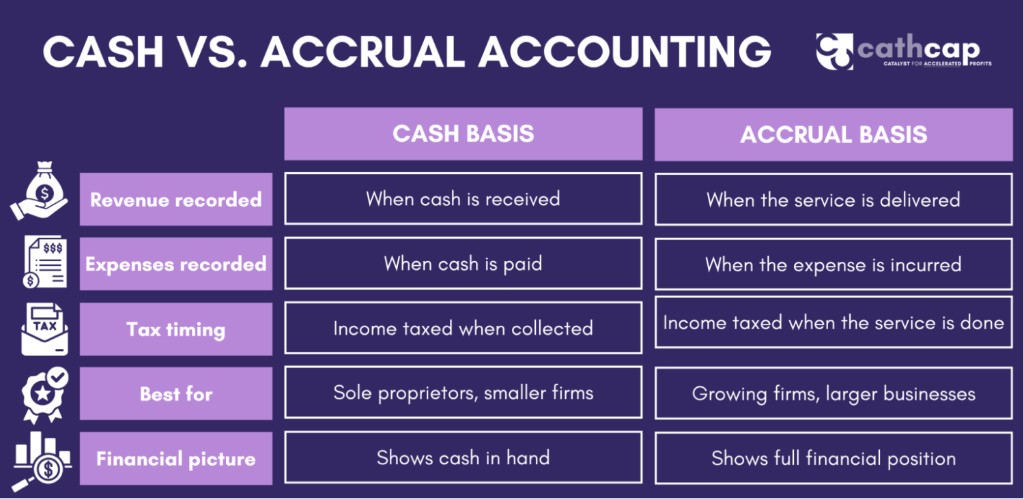
The table below shows how the two methods compare across the dimensions that matter most to small sellers.
| Factor | Cash Accounting | Accrual Accounting |
|---|---|---|
| When income is recorded | Cash received | Revenue earned |
| When expenses are recorded | Cash paid | Expense incurred |
| Complexity | Low | High |
| Tax timing flexibility | Higher (near-term deductions) | Lower |
| Accounts receivable tracking | Not required | Required |
| Accounts payable tracking | Not required | Required |
| Inventory cost matching | Not precise | Precise |
| Best for | Small ecommerce, Etsy, Shopify | Mid-to-large, inventory-heavy businesses |
When Accrual Accounting Actually Makes Sense
Accrual accounting is not wrong. It is simply designed for a different kind of business.
The core argument for accrual, as A2X Accounting outlines, is that it matches costs with the revenue those costs helped generate in the same accounting period. For a business manufacturing and selling furniture in volume, this matching matters enormously. If a company produces 500 dining tables in October using $80,000 in raw materials and sells them across October, November, and December, accrual accounting ensures that the cost of each table is recognized in the same period as its sale. That gives management a precise gross margin for each period rather than a distorted picture driven by when checks cleared.
This is also why the U.S. GAAP standards and most lenders require accrual-basis financial statements from companies seeking financing or preparing audited reports. A balance sheet prepared under accrual accounting captures what the business truly owns and owes at a point in time, not just what has flowed through the bank account recently.
For small ecommerce sellers, though, these advantages rarely outweigh the added workload. If you are buying finished goods from a supplier and reselling them, or if you are a maker producing in small batches, precise inventory cost matching is useful conceptually but often not worth the bookkeeping overhead at small scale. Most small sellers do not have a controller or accounting staff. Every hour spent reconciling accrual entries is an hour not spent on product, marketing, or customer service.
Accrual becomes worth the trade-off when a seller crosses into consistent six-figure annual revenue, carries significant inventory that needs to be valued on a balance sheet, plans to seek business financing, or has investors or partners who need GAAP-compliant statements. At that point, investing in proper ecommerce accounting software designed to automate accrual entries becomes a practical necessity rather than a luxury.
Source: CathCap
Practical Steps to Set Up Cash-Basis Books for Your Shop
Getting cash accounting right from the start saves significant cleanup later. Here is how to structure it.
Separate your business and personal finances first. Open a dedicated business checking account and route all Etsy or Shopify payouts there. This is the single most important step the SBA recommends for managing business finances, and it makes cash-basis recording straightforward because every transaction on the business account is a business transaction.
Record payouts, not individual sales. Etsy deposits net payouts after deducting its transaction fees, listing fees, and payment processing fees. Record the gross payout amount as income and the platform fees as a separate expense line. This keeps your revenue figure accurate and your fee expenses visible.
Categorize expenses consistently. Common ecommerce expense categories include cost of goods sold (materials or wholesale inventory), shipping and postage, platform fees, advertising, packaging supplies, and home office or studio costs. Consistent categorization makes Schedule C filing much simpler at year end.
Reconcile monthly. Cash accounting does not eliminate the need to reconcile. Match your recorded income and expenses to your actual bank and payout statements every month. A small discrepancy caught in month two is far easier to fix than one discovered in April during tax season.
Know your IRS eligibility. Most sole proprietors and single-member LLCs with average annual gross receipts under $30 million over the prior three years can use the cash method, per IRS Publication 334. If you have inventory, the rules get more nuanced, so confirm your situation with a tax professional. For a deeper look at how to analyze your shop's actual profitability once your books are in order, the Etsy Profit Calculator can help you stress-test your margins.
For most Etsy and Shopify sellers running lean operations, cash accounting keeps bookkeeping manageable, tax preparation straightforward, and cash flow transparent. Accrual accounting is a powerful tool for the right business at the right scale. For a seller with under $500,000 in annual revenue and no outside investors or lenders requiring GAAP statements, that scale is almost never now. Start with cash, keep clean monthly records, and revisit the question only when your business complexity genuinely demands it.
Related reading: Best Accounting Software for Etsy Sellers in 2026 · Best Etsy Profitability Tools in 2026 to Maximize Your Earnings · Best Etsy Seller Tools in 2026: Research, SEO, and Analytics
Sources
- A2Xaccounting: Cash vs. Accrual Accounting for Small Ecommerce Sellers
- Etsy Seller Fees
- Investopedia — Accounting Equation.asp
- Investopedia — Double Entry.asp
- IRS Publication 334 (Tax Guide for Small Business) — Publications
- IRS Small Business and Self-Employed — Manage Your Business
- Sba — Manage Business Finances