
Rent is often the largest line item in a household budget. Get it wrong and everything else feels tight: groceries, debt payments, and savings all compete with a fixed housing bill you cannot unwind without moving. The question "how much rent can you afford" is really two questions: what lenders and landlords will accept, and what leaves enough room for the rest of your life.
The 30% rule
The most cited benchmark comes from HUD: households that spend more than 30% of income on rent and utilities are cost-burdened. That 30% figure is why planners, landlords, and housing researchers keep returning to it. It is easy to remember and gives property managers a quick screen.
But "30%" is a midpoint, not a ceiling everyone should hit. Financial educators often cite a 20–30% range for renters who want extra room for savings and debt payoff. Some landlords approve applicants at up to 40% of gross income, and mortgage underwriters use a related 28/36 rule (28% for housing, 36% for all debt). Our Rent Affordability Calculator lets you slide between 15% and 40% so you can see conservative and stretch scenarios side by side.
A separate rule you will hear at lease signings: monthly income should be at least three times the rent. That is the same math flipped. A $1,800 apartment implies roughly $5,400 in gross monthly income, which works out to about 33% of pay going to rent.
Example: $5,000 gross per month ($60,000 per year)
| Guideline | Share of gross | Max base rent |
|---|---|---|
| Conservative floor | 20% | $1,000 |
| Lower planner range | 25% | $1,250 |
| HUD / common standard | 30% | $1,500 |
| 3× rent landlord screen (~33%) | 33% | $1,650 |
| Upper stretch ceiling | 40% | $2,000 |
Example: $6,000 gross per month ($72,000 per year)
| Guideline | Share of gross | Max base rent |
|---|---|---|
| Conservative floor | 20% | $1,200 |
| Lower planner range | 25% | $1,500 |
| HUD / common standard | 30% | $1,800 |
| 3× rent landlord screen (~33%) | 33% | $2,000 |
| Upper stretch ceiling | 40% | $2,400 |
The gap between 20% and 40% on a $6,000 paycheck is $1,200 per month, or $14,400 per year. That is the difference between a tight budget with little savings cushion and a lease that leaves almost no margin for a car repair or a slow month at work.
Do not confuse this with the 50/30/20 budget (50% needs, 30% wants, 20% savings). In that framework, housing is one slice of the 50% needs bucket, alongside groceries, insurance, and transportation. A household can follow 50/30/20 and still aim for rent near 30% of gross, but the two rules measure different things.
The 30% rule is a starting point, not a law. In high-cost metros, many households exceed it and compensate elsewhere. In lower-cost areas, you might choose less rent to accelerate savings or debt paydown. What matters is the whole budget: utilities, insurance, commuting, childcare, and emergency savings still need space.
Gross vs. take-home
Landlords and the HUD cost-burden definition use gross income (pre-tax wages). That is what appears on a pay stub before federal and state withholding, plus any 401(k) or health-premium deductions.
Take-home pay is what actually lands in your checking account. For many W-2 workers, net pay runs roughly 70–80% of gross, depending on tax bracket, state taxes, and benefits. That gap matters when you compare rent rules:
- 30% of $6,000 gross = $1,800 rent target
- 30% of $4,500 take-home = $1,350 rent target
- The same $1,800 lease is 40% of take-home, not 30%
Some planners therefore recommend 25–30% of take-home pay for rent when you are building an emergency fund or paying down high-interest debt. Others keep the 30% gross rule but add utilities, renters insurance, and parking into the housing bucket so the true shelter cost is visible.
Before you sign, list:
- Base rent
- Renter's insurance
- Average utilities (ask the landlord or a neighbor)
- Parking or storage fees
- Move-in costs spread over the first year (deposit, application fees)
If the all-in number breaks your plan, the headline rent was never affordable.
Rising rental costs and affordability pressure
Housing costs have pressured budgets nationwide, and the data show it is not limited to a few coastal cities. According to the Harvard Joint Center for Housing Studies (America's Rental Housing 2026), a record 22.7 million renter households were cost-burdened in 2024, meaning they spent more than 30% of income on rent and utilities. That is 49% of all U.S. renters, up 8.8 percentage points since 2001. Another 12.1 million households (26%) are severely burdened, spending more than half of income on shelter.
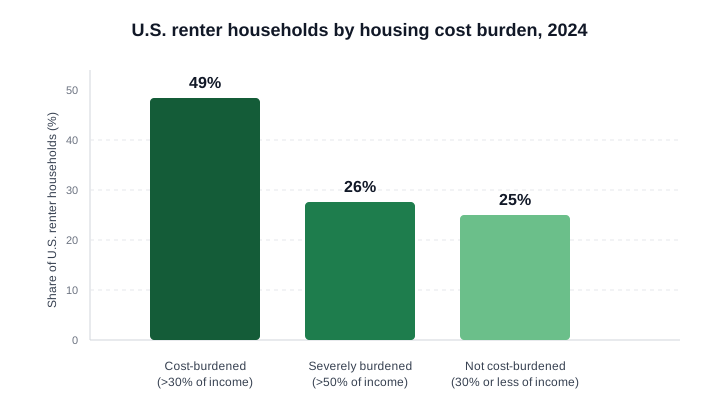
Source: JCHS tabulations of U.S. Census Bureau American Community Survey, via America's Rental Housing 2026
The squeeze is climbing the income ladder. Among renters earning $30,000 to $44,999, 72% were cost-burdened in 2024. For those earning $45,000 to $74,999, just over 49% were burdened, up 24.3 percentage points since 2001. Even middle-income renters are now as likely as not to exceed the 30% threshold.
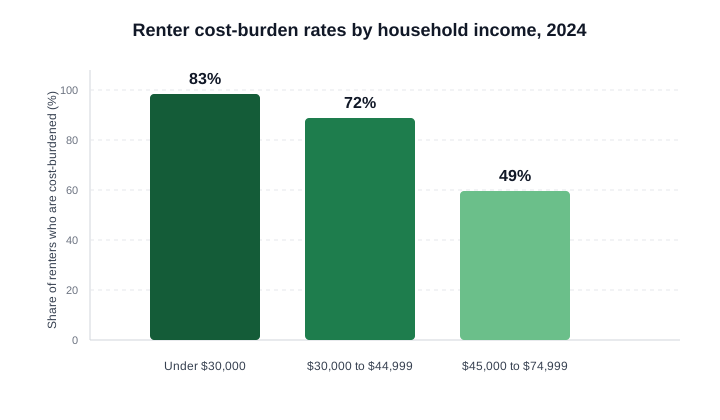
Source: JCHS, America's Rental Housing 2026
On the price side, the U.S. Bureau of Labor Statistics shelter index has been one of the largest contributors to inflation readings households feel directly. Zillow's March 2026 rent report puts the typical U.S. asking rent at $1,910, and estimates a household now needs about $76,400 per year to comfortably afford that payment, roughly 35% more income than before the pandemic. The national typical asking rent rose sharply from 2021 through 2022, cooled somewhat in 2023–2024, and remains well above pre-pandemic levels.
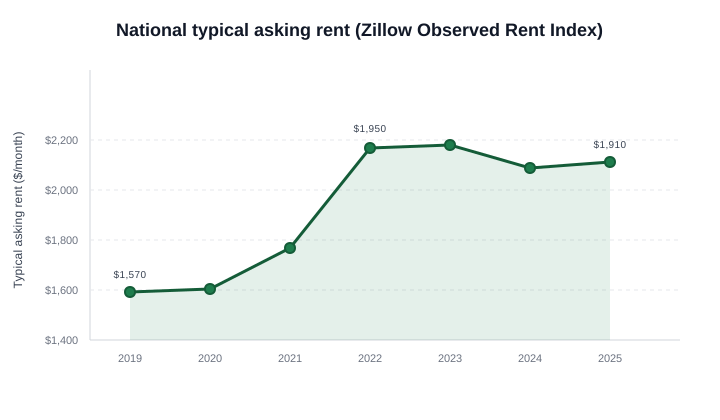
Source: Zillow Observed Rent Index national typical asking rent, rounded annual values
The JCHS report also notes that the number of rental units with asking rents below $1,400 fell by 9.3 million between 2014 and 2024, shrinking the supply of naturally affordable homes even as vacancy rates ticked up in some markets. Cooling rent growth has not reversed decades of rising costs and stagnant wage growth for many renters.
That does not mean you should accept any rent payment. It means you should compare options (roommates, slightly longer commutes, timing a lease renewal) with eyes open, and run your own numbers against both the 30% benchmark and a more conservative floor.
Stress-test with a calculator
Rules of thumb answer "what might a landlord approve?" A stress test answers "what happens in a normal bad month?"
Related free tool: Rent Affordability Calculator. Enter gross monthly or annual income, then drag the rent-to-income slider from 15% to 40%. The tool shows a max monthly rent and annual rent at that percentage. Start at 30%, then slide down to 25% or 20% to see how much breathing room a more conservative cap buys you.
Layer three quick checks on top of the calculator output:
- Add the all-in housing stack (utilities, insurance, parking) to the base rent the tool returns. If that total crosses 30–35% of gross, the advertised rent is already a stretch.
- Subtract fixed non-housing bills (car payment, student loans, childcare) from take-home pay, then see what share the full housing stack consumes. This catches cases where 30% gross rent still leaves too little for everything else.
- Run downside scenarios: one missed paycheck, a $200 winter utility spike, or a $500 car repair in the same month rent is due. If only the "perfect month" works, the apartment is too expensive.
The calculator is a starting range. Pair it with a full budget (category limits, a minimum savings transfer, and honest flexible spending caps) before you sign.
Evaluate rent within your overall budget
Affordable rent is just one piece of your overall budget management strategy, not the other way around. It is critical to pair a housing target with category budgets, a minimum monthly savings target, and honest flexible spending limits. When rent fits inside that picture, you gain strong financial health and stability.
Related reading: Budgeting 101: Get Started on Budgeting and Expense Tracking for Free · How Budgeting Can Save You Money
Sources
- HUD — Comprehensive Housing Affordability Strategy (30% cost-burden definition)
- Harvard Joint Center for Housing Studies — America's Rental Housing 2026
- Zillow Research — March 2026 Rent Report
- Zillow Research — Observed Rent Index data
- U.S. Bureau of Labor Statistics — Consumer Price Index (shelter)